About Me
Hi there! I'm Nat Kerman, a PhD student in the Department of Astronomy at the University of Massachusetts Amherst. My research focuses on understanding how objects like exoplanets and brown dwarfs form, using multi-wavelength observations from JWST and ALMA.
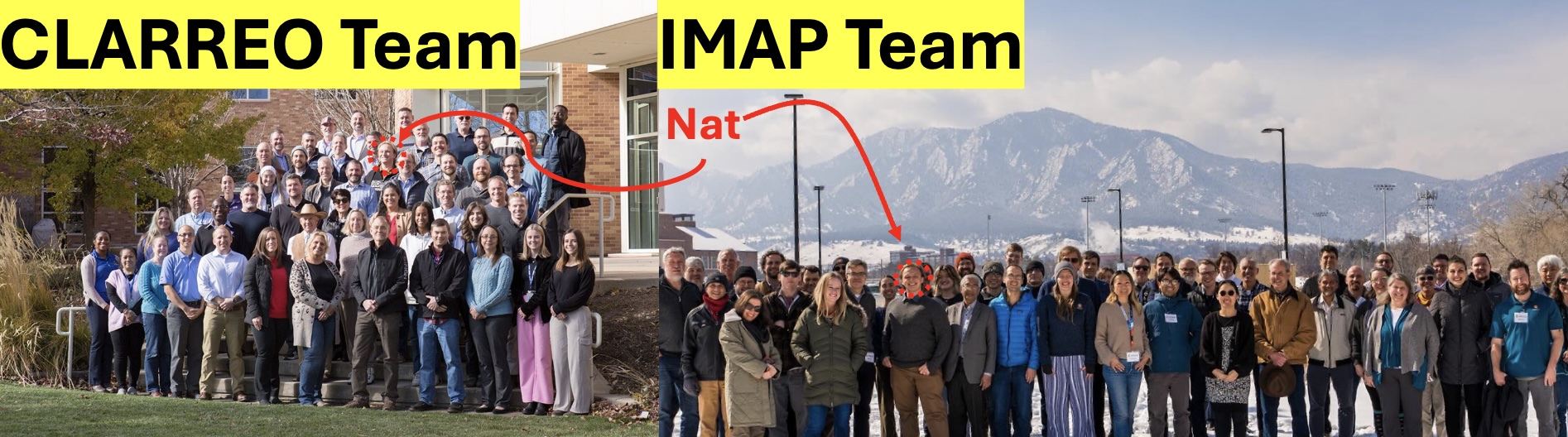
Before graduate school, I spent five years working on space telescope operations and scientific instrumentation — first at the Space Telescope Science Institute (STScI) supporting the Hubble Telescope's Cosmic Origins Spectrograph (COS), and then at the Laboratory for Atmospheric and Space Physics (LASP) building data systems for climate and heliophysics missions like CLARREO and IMAP.
I have a background teaching scientific computing and data analysis. I taught the upper-level undergraduate course on scientific data analysis and computing at CU Boulder.
Education & Experience
2025 – present
PhD Student in Astronomy
University of Massachusetts Amherst
Actively researching young planetary mass objects as they are still in the midst of forming using data from JWST, ALMA, and other telescopes.
2022 – 2025
Data Systems Software Engineer III
Laboratory for Atmospheric and Space Physics (LASP), CU Boulder
Worked on heliophysics missions and climate satellites, developing data processing pipelines for solar and climate measurements. Contributed to the CLARREO, IMAP-Ultra, IMAP-Hi, and IMAP-Lo instruments.
2020 – 2022
Science Support Analyst
Space Telescope Science Institute (STScI)
Supported operations for the Hubble and James Webb Space Telescopes. Led calibration efforts for the Cosmic Origins Spectrograph (COS) at Lifetime Position 6, including characterization of spectral and spatial resolution.
2016 – 2020
B.S. (Honors) in Astrophysics
Yale University
Undergraduate research included Undergraduate thesis characterizing the EXPRES spectrometer, improving its wavelength calibration to precisely measure radial velocities and enable exoplanet detection. Additional research with Simons Observatory, Dragonfly Telephoto Array, and Hubble observations of galaxy clusters.
Skills & Competencies
Technical
- •Python (NumPy, SciPy, Astropy, Plotting, Machine Learning)
- •Scientific data pipeline development
- •Git, Linux/Unix, SQL
- •Basic optical modeling
Scientific
- •Scientific literature writing, reading, & review
- •Scientific education, communication, & mentoring
- •Scientific data pipeline design
- •Spectroscopic calibration & analysis
- •UV / Optical / IR / mm instrumentation
- •JWST, ALMA, Hubble data analysis
- •Exoplanet detection & characterization
- •Heliophysics, Earth, & Climate science